
How Much Does a Murphy Bed Cost? Ranges & Long-Lasting Options

Murphy Bed Costs: Key Takeaways
- Murphy beds range widely in price, typically from $800 to over $8,600 depending on size, materials, mechanism quality, and design complexity
- Handcrafted, solid-wood Murphy beds offer the best long-term value, lasting decades longer than mass-produced particleboard alternatives
- Mechanism quality matters: Premium lift systems ensure smoother, safer daily operation and significantly affect cost
- Custom cabinetry, finishes, and multifunctional features (desks, shelves, towers) increase the price but dramatically improve functionality
- Installation needs can impact the total investment, especially in rooms that require reinforcement or custom fitting
- Queen Murphy beds provide the best balance of comfort and value, making them the most popular choice for multipurpose spaces
There’s a room in every home that could be doing more.
Maybe it’s the guest bedroom that sits empty 300 nights a year. Or the office that moonlights as a storage closet. These are the in-between spaces, full of potential, but not quite living up to it.
That’s where a Murphy bed changes everything. With a single motion, a static room becomes a sleeping space, a study, a sanctuary.
But here’s the catch: not all Murphy beds are built alike.
Prices range from budget models made of particleboard to handcrafted hardwood designs that feel like built-in furniture.
So, the real question isn’t “What does a Murphy bed cost?” It’s “What makes it worth the investment?”
Want a bed that works as hard as your space does?
Discover Legacy Handcraft’s Murphy Beds
How Much Does a Murphy Bed Cost?
A Murphy bed typically costs anywhere from $800 to over $8,600, depending on the materials, mechanism, craftsmanship, and any added cabinetry or features.
Entry-Level Murphy Beds ($800–$1,500)
Usually made from:
- Particleboard or MDF
- Basic or imported mechanisms
- Minimal cabinetry
Best for occasional use. These beds are functional but not designed for daily wear or long-term durability.
Mid-Range Murphy Beds ($1,500–$3,000)
Often built with:
- Mixed materials (veneered plywood + small hardwood accents)
- Better but not premium lift mechanisms
- Optional shelving or simple cabinetry
A decent balance of quality and affordability, but still not built for generations of use.
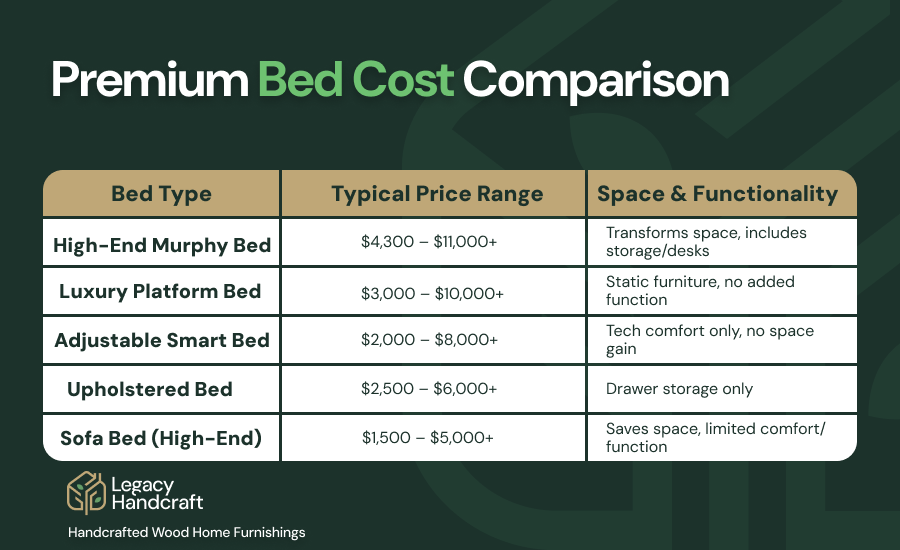
High-End Heirloom Murphy Beds ($4,300–$8,600+)
This category includes handcrafted, solid-wood Murphy beds like Legacy Handcraft’s.
These beds feature:
- Solid hardwood construction (oak beds, walnut beds, maple beds, no particleboard)
- Precision joinery and premium-rated lift hardware
- Smooth, quiet operation designed for daily use
- Bespoke finishes, cabinetry, desks, or storage towers
- Artisan craftsmanship that ages beautifully over decades
Legacy Handcraft’s Murphy Bed is a perfect example: a solid-wood, heirloom-quality design crafted to bring lasting beauty
Where Legacy Handcraft Fits Into These Ranges
Legacy offers the best Murphy beds that belong in the high-end, heirloom-quality category, offering:
- Superior structural integrity
- Safer, long-lasting mechanisms
- Timeless design
- Solid hardwood construction throughout
- Handcrafted quality that mass-produced beds can’t match
They’re an investment, but one designed to last as long as the home itself.
Why Prices Vary So Much
A Murphy bed’s price depends primarily on:
- Bed size (twin vs queen)
- Wood type
- Cabinetry complexity
- Mechanism durability
- Installation requirements
- Custom add-ons
What Affects the Cost of a Murphy Bed?
It’s not just about the size or the style. Price is also shaped by the materials, the mechanism, the orientation, and the craftsmanship behind the build.
High-quality construction matters just as much for beauty as it does for safety and long-term durability.
Bed Size and Orientation (Vertical vs. Horizontal)
Size is one of the biggest cost factors, simply because larger beds require more material, stronger hardware, and more labor to build.
To understand how size and orientation affect pricing:
- Larger murphy beds (especially queen) require more wood, heavier mechanisms, and sturdier framing
- Vertical orientations murphy beds tend to be more common and generally more affordable, particularly when ceiling height allows for standard installation
- Horizontal Murphy beds may require alternate hardware or cabinetry to fit low ceilings or tight layouts
- Ceiling height and room shape can impact which orientation is possible, and therefore, the final cost
Material quality has one of the biggest impacts on cost and longevity. The difference between real hardwood and engineered wood is dramatic in both feel and lifespan.
Wood Type and Material Quality
Here’s how material choice shapes pricing:
- Hardwoods such as walnut, oak, and maple offer consistent strength and visual character that improve with age, making them ideal for furniture built to last
- Engineered woods and particleboard lower the upfront cost but limit lifespan and load capacity, especially with daily use
- Heirloom-quality Murphy beds rely on solid woods, precision joinery, and artisan craftsmanship that’s built to last decades, not just seasons
Mechanism Type and Durability
The lifting mechanism is the heart of the Murphy bed. Its quality directly impacts safety, noise, smoothness, and long-term reliability.
To compare mechanisms effectively:
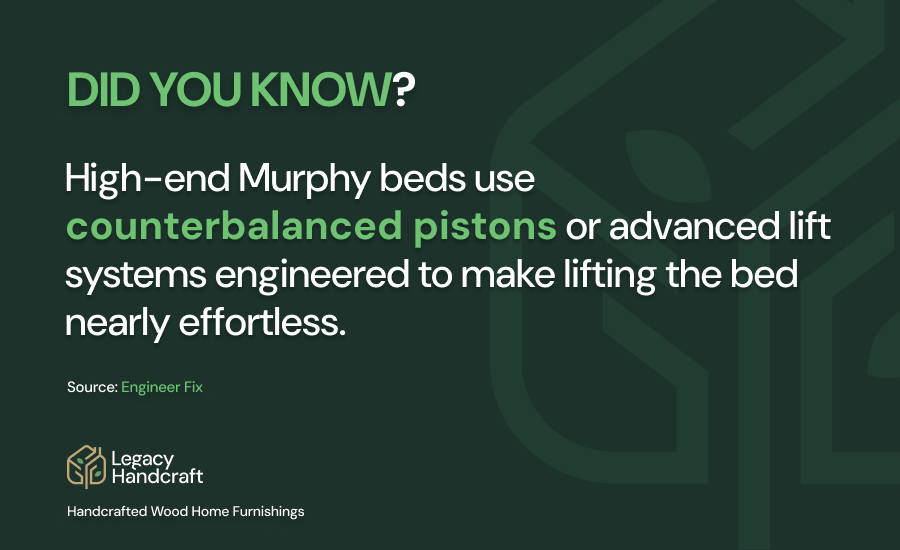
- Counterbalance and piston systems offer the smoothest, safest, and most effortless operation
- Higher-end mechanisms are engineered for daily use, reducing wear and preventing sagging or sudden drops
A premium mechanism costs more upfront, but it ensures the bed operates safely and silently for years.
Bring heirloom-level craftsmanship into your home.
Start your Murphy bed quote
Murphy Bed Add-Ons That Increase the Cost
Once you choose the size, orientation, and core build of your Murphy bed, the next pricing layer comes from the add-ons.
Each upgrade increases materials, craftsmanship, and labor, which is why they influence the overall cost.
Here are the most common add-ons and how they typically affect pricing:
- Built-in cabinets, shelves, or storage towers (+$800–$3,000+): Additional woodwork requires more materials and labor, especially when crafted from solid hardwood. These upgrades are ideal for small spaces that need vertical storage, display areas, or nightstand alternatives
- Soft-close hardware and upgraded mechanisms (+$150–$800): Premium hinges and higher-end lift systems make the bed quieter, smoother, and safer to operate. They also reduce long-term wear and offer a noticeably more refined experience
- Custom finishes, stains, and premium handles (+$200–$1,200+): Custom stain-matching, hand-finished surfaces, and specialty hardware add build time and artistry. These upgrades create a personalized look and give the Murphy bed an heirloom-level aesthetic that feels intentional and elevated
- Integrated features like desks, lighting, or built-in charging (+$300–$2,500+): Multipurpose features require added engineering and cabinetry but increase the bed’s usefulness in home offices, studios, or guest rooms
- Decorative face panels or full cabinetry enclosures (+$500–$2,000+): Adding doors, paneling, or a fully enclosed front creates a furniture-like presence and helps the bed blend seamlessly into the room
Why Handcrafted Murphy Beds Cost More but Last Longer
When you compare Murphy beds across the market, it becomes clear that not all beds are built the same. Simply put, some are not built to last.
This is where the difference between mass-produced and artisan-crafted really matters.
Craftsmanship and Joinery
Handcrafted Murphy beds require far more time, precision, and skill than factory-built alternatives.
- Experienced artisans shape, fit, and join each component by hand
- Traditional joinery techniques create strength and stability that machines simply can’t replicate
- Each bed is built in small batches, ensuring true quality control, not assembly-line shortcuts
This level of craftsmanship results in furniture that feels solid, moves smoothly, and ages beautifully.
Real Hardwood vs. Particleboard
Materials are one of the biggest contributors to both cost and longevity.
- Solid hardwoods like walnut, oak, and maple remain stable, strong, and gorgeous over decades of daily use
- Wood movement is predictable and controlled, making hardwood ideal for a mechanical piece like a Murphy bed
- Particleboard and MDF, on the other hand, break down under repeated stress, sag with weight, and react poorly to humidity or everyday wear
Choosing real wood is choosing a bed that will still feel sturdy 10, 20, even 30 years from now.
Long-Term Durability and Safety
A handcrafted Murphy bed isn’t just built to last, it’s built to operate safely and silently for years.
- High-quality lift mechanisms are rigorously tested and engineered for daily use
- Better hardware equals smoother folding, quieter motion, and less wear over time
- Expert murphy bed installation ensures the bed is anchored safely and securely into your wall structure
Legacy Handcraft Murphy Beds: Crafted for Homes That Value Beauty and Longevity
A Murphy bed is more than a space-saving solution, it’s an anchor piece that should feel reliable, beautiful, and built for everyday life.
When you choose a handcrafted Murphy bed made from solid hardwood, you’re choosing a piece designed to serve your home for decades.
Legacy Handcraft Murphy beds stand apart for their:
- Heirloom-level craftsmanship shaped by skilled artisans
- Precision joinery that creates true structural strength
- Solid hardwood construction designed to age gracefully
- Premium lift mechanisms engineered for quiet, safe, daily use
- Small-batch, custom builds that never feel mass-produced
Legacy Handcraft creates furniture that’s meant to be lived with, admired, and passed on, pieces that bring warmth and intention into every room they touch.
Whether you’re refreshing a single room or rethinking how your home flows, Legacy offers handcrafted pieces that elevate both style and function:
Ready to reclaim your space?
Explore handcrafted Murphy beds.
How Much Does a Murphy Bed Cost: FAQs
If you’re still sorting through the details or comparing your options, these quick answers will help you understand what really goes into Murphy bed pricing.
How much does a Murphy bed cost?
Pricing for Murphy beds can fall anywhere between $800 and $8,600+, depending on construction, size, and additional features. On the lower end, expect simpler materials like a particleboard. At the high end, craftsmanship and hardwood construction elevate both the look and the lifespan of the bed.
How much does a queen size Murphy bed cost?
A queen Murphy bed usually falls between $1,500 and $8,600+, depending on craftsmanship and materials. Queen beds require more wood, stronger hardware, and heavier mechanisms, all of which influence the cost.
What affects the cost of a Murphy bed the most?
The biggest factors are size, material quality, and mechanism durability. Solid hardwood significantly increases longevity, while premium lift systems ensure smooth and safe daily use. Cabinetry, shelving, and custom finishes also affect prices.
Are Murphy beds worth the investment?
Yes. Especially if you need flexible space that works hard every day. A well-built Murphy bed frees up valuable square footage, adds function to small rooms, and offers comfortable sleeping without sacrificing style. High-quality hardwood beds last far longer than budget builds, making them a smart long-term investment in your home.
Do Murphy beds require professional installation?
Professional installation is strongly recommended. Murphy beds must anchor securely into studs or reinforced walls, and proper alignment ensures the mechanism works safely and smoothly.
Is it cheaper to build a Murphy bed yourself?
Building your own Murphy bed can reduce upfront costs, but it requires specialized tools, time, and skill. You’ll need to purchase a mechanism kit, quality lumber, hardware, and finishing materials. And the final result may not match the strength or safety of a professionally crafted bed.
Are horizontal Murphy beds more expensive than vertical ones?
Not always, but horizontal beds can cost more depending on layout, cabinetry needs, and ceiling height constraints. They often require different mechanisms and structural components. Vertical beds are more common and sometimes more budget-friendly, but orientation should be chosen based on your space rather than price alone.
Transform your room with furniture built to last
Explore handcrafted Murphy beds.


