
Best Wood for a Fireplace Mantel: Top Options & Buying Guide

Best Wood for a Fireplace Mantel: Key Takeaways
The best wood for a fireplace mantel is white oak for most homes. It is hard (1,360 lbf on the Janka scale), stable near heat, and takes stain well. Choose black walnut for a dark, modern look, hard maple for a light, painted or Scandinavian look, and reclaimed barn wood for rustic character. Whatever wood you pick, the clearance between the mantel and the firebox matters more for safety than the species.
Legacy Handcraft builds solid and reclaimed wood mantels by hand in all of these species. This guide compares them on hardness, heat safety, style and price.
- Best overall: white oak, for durability, stability and stain flexibility.
- Best for modern rooms: black walnut, for its dark, even tone.
- Best for rustic rooms: reclaimed wood, for texture and patina no new board can copy.
- Best on a budget: hemlock or pine, mainly for gas or electric fireplaces.
- Typical cost: $500 to $3,500 for most solid wood mantels, and $5,000+ for custom or oversized pieces.
Fireplaces remain a sought-after feature. In the National Association of Home Builders’ buyer survey, 55% of buyers rated a gas fireplace desirable and 48% said the same of a wood-burning one. The mantel is what makes that fireplace the focal point of the room.
Bring the warmth of handcrafted wood into your home
Explore Legacy Handcraft
Best woods for a fireplace mantel compared
Hardness, measured on the Janka scale, shows how well a wood resists dents. Higher numbers mean a harder wood.
Hardness, measured on the Janka scale, shows how well a wood resists dents. Higher numbers mean a harder wood.
- Hard maple (1,450 lbf): light, fine, even grain. Works with any fireplace. Best for Scandinavian, coastal and painted looks.
- White oak (1,360 lbf): light to mid tan with visible grain. Works with any fireplace. Best for modern, transitional and traditional rooms.
- Red oak (1,290 lbf): warm, pinkish tone with open grain. Works with any fireplace. Best for traditional and farmhouse rooms.
- Black walnut (1,010 lbf): dark chocolate brown. Works with any fireplace. Best for modern, contemporary and minimalist rooms.
- Hemlock (500 lbf): pale with straight grain. Best with gas or electric fireplaces. A good transitional or budget pick.
- Eastern white pine (380 lbf): pale yellow and knotty. Best with gas or electric fireplaces. A good rustic or budget pick.
- Reclaimed wood (hardness depends on species, often oak, pine or hemlock): weathered, with nail holes and saw marks. Works with any fireplace if kiln-dried and clearance is met. Best for rustic, farmhouse and industrial rooms.
Janka values: Wikipedia, Janka hardness test.
A mantel is not a floor. It rarely takes hard knocks, so a softer wood like walnut holds up fine. Hardness matters most if you hang stockings, swap heavy decor often, or have kids who climb.
What To Consider When Choosing Wood for a Fireplace Mantel
Four things decide the right wood: safety clearance, stability, look and sourcing.
- Clearance (the safety rule): All wood burns, whatever its density. For masonry fireplaces, IRC section R1001.11 bans combustible material within 6 inches of the fireplace opening. Between 6 and 12 inches, wood may stick out only 1/8 inch for each inch of distance. That means 3/4 inch at 6 inches and 1 1/2 inches at 12 inches. Beyond 12 inches, any depth is allowed. Factory-built and gas units follow the manufacturer’s listed clearances. Always check your local code.
- Stability: Dense, well-dried hardwoods like oak and maple are less likely to cup, crack or shift as the room heats and cools.
- Look: Grain and tone set the mood. Reclaimed wood reads rustic. Walnut and white oak read modern.
- Sourcing: Reclaimed and responsibly harvested wood cuts the need for new timber.

5 Best Wood Mantel Choices
Some woods bring warmth and rustic charm, while others offer a refined, modern edge. The key is finding a material that complements your space and holds up beautifully over time.
Below are some of the most popular (and timeless) wood choices homeowners and designers trust for their mantels.
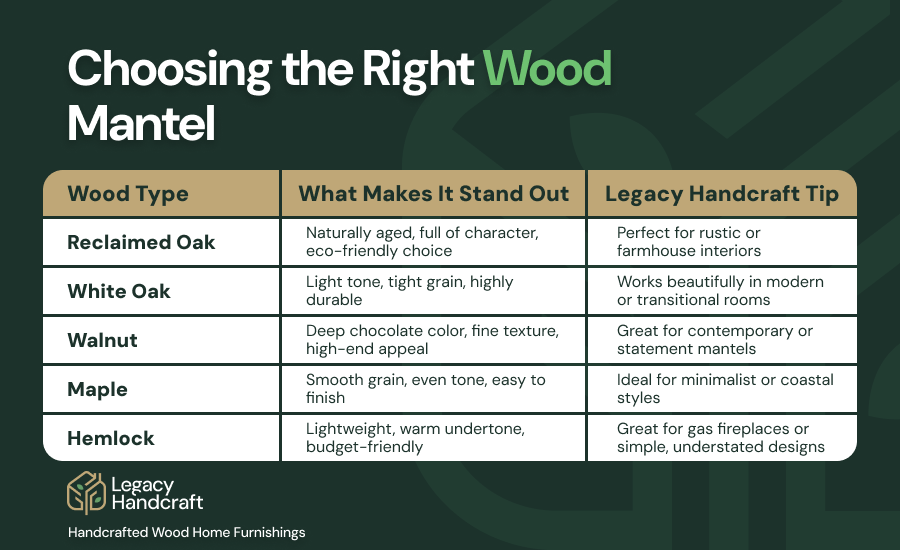
1. Reclaimed wood: best for rustic character
Reclaimed wood is the best choice if you want a mantel with history. Each beam carries saw marks, nail holes and a weathered patina that new lumber cannot copy.
- Fits farmhouse, cottage, mountain and industrial homes.
- Reuses old timber, so no new trees are cut.
- Looks striking against brick, stone or white walls.
- Make sure it is kiln-dried and free of old finishes or pests before it goes near hea
Legacy tip: Legacy Handcraft’s reclaimed oak beam mantels are sourced from century-old American barns and hand-finished to highlight every detail, bringing timeless craftsmanship into today’s homes.
Related resource: Why Reclaimed Wood Floating Shelves Are a Décor Must-Have →
2. Oak: best all-around mantel wood
Oak is the best all-around choice because it is hard, stable and fits almost any style. White oak rates 1,360 lbf and red oak 1,290 lbf on the Janka scale. White oak has a typical density of about 0.75 g/cm³.
- Resists warping and cracking when properly dried.
- Takes stain well, from pale natural to deep brown.
- White oak suits modern rooms; red oak’s warmer tone suits traditional ones.
Legacy tip: For clean lines and warm tones, explore Legacy Handcraft’s white oak box mantels, designed for modern and transitional spaces.
3. Walnut: best for a modern, high-end look
Black walnut is the best choice for a dark, refined mantel. Its chocolate-brown tone makes an instant focal point against light walls.
- Softer than oak (1,010 lbf) but stable and plenty tough for a mantel.
- Looks best with a clear or oil finish that shows the natural color.
- Suits modern, contemporary and minimalist homes.
Legacy tip: Add warmth and contrast with Legacy Handcraft’s black walnut box mantels, handcrafted to accentuate walnut’s fine grain and deep color variations.
4. Maple: best for light and painted finishes
Hard maple is the best choice for a light, smooth mantel. At 1,450 lbf, it is the hardest wood on this list.
- Fine, even grain with few visible pores.
- Takes paint and whitewash cleanly.
- Can blotch under dark stain, so a pre-stain conditioner or gel stain helps.
- Suits Scandinavian, coastal and minimalist rooms.
Legacy tip: Maple’s fine grain also makes it a great base for custom finishes or paint, which is a go-to choice for homeowners seeking a fresh, airy look.
5. Hemlock and pine: best budget options
Hemlock and pine are the best budget picks, especially for gas or electric fireplaces with lower heat. Both are softwoods, so they dent more easily (500 and 380 lbf).
- Lighter weight, so they are easier to cut and mount.
- Pine often stains blotchy; use a pre-stain conditioner or gel stain for an even color.
- Hemlock stains more evenly than pine and has a straight, clean grain.
Legacy tip: Explore Legacy Handcraft’s hemlock box mantels, a versatile, handcrafted choice for transitional homes that want character without the heavy weight of hardwood.
Rustic vs. Modern Mantel Wood Styles
Both styles have their charm; it just depends on what kind of story you want your space to tell.
Rustic mantels embrace flaws and texture; they feel lived-in and inviting. Modern mantels, on the other hand, are all about clean cuts, soft finishes, and understated presence.
Rustic Mantel Styles Rustic
Mantels show texture and age; modern mantels show clean lines and smooth grain.
Best wood for a rustic mantel: reclaimed oak or pine, for their knots, saw marks and weathered color. Best wood for a modern mantel: white oak or black walnut in a slim, flush-mounted box.
Rustic mantels:
- Woods: reclaimed barn wood, distressed oak or pine.
- Surface: knots, saw marks and nail holes.
- Profile: a chunky beam.
- Pairs with: stone, brick or shiplap.
- Home styles: farmhouse, cottage and mountain.
Modern mantels:
- Woods: white oak, walnut or maple.
- Surface: smooth, even and sanded.
- Profile: a slim, flush-mounted box.
- Pairs with: plaster, tile or painted drywall.
- Home styles: contemporary, Scandinavian and transitional.
Bring the warmth of handcrafted wood into your home
Explore Legacy Handcraft
How much does a wood fireplace mantel cost?
Most solid wood mantels cost $500 to $3,500. Custom or oversized pieces can pass $5,000.
- Standard box mantel (hemlock, maple or oak, up to 6 ft): $500–$1,200
- Premium hardwood (walnut, cherry, custom stain): $1,200–$2,500
- Reclaimed or heavily distressed beam: $1,800–$3,500+
- Custom-sized, sculpted or exotic wood: $2,500–$5,000+
What Drives the Price Higher?
- Species: walnut and reclaimed beams cost more because supply is limited.
- Size: longer and deeper mantels use more wood and labor.
- Finish and edges: custom stains and hand-shaped edges add shop time.
- Mounting: hidden brackets and flush mounts need extra hardware and labor.
- Shipping: heavy hardwood costs more to freight.
Why Legacy Handcraft Mantels Are the Best Choice
A fireplace mantel is more than just wood; it’s a statement of craftsmanship, warmth, and permanence. At Legacy Handcraft, we believe the materials you choose should tell a story, one built on quality, history, and attention to detail.
Each mantel starts at the hands of a skilled woodworker, no mass production, just careful shaping and finishing to bring out the best in every grain
When you choose us, you’re choosing:
- Real materials: solid and reclaimed hardwoods only.
- Handwork: each mantel is shaped and finished by a woodworker.
- Custom options: sizes, stains and mounting styles made to fit.
- Reclaimed sourcing: many beams come from [confirm: historic barns].
- Long life: built to last decades as the center of the room.
We don’t just make mantels, we craft legacy pieces that bring your space to life, one beam at a time.
CTA: Explore handcrafted mantels at Legacy Handcraft. Contact us.
Best Wood for Fireplace Mantel: FAQs
What is the best wood for a fireplace mantel?
If you want something classic and durable, oak is a fantastic choice: strong, beautiful, and easy to stain. For a modern, high-end look, walnut adds rich, dark tones that instantly elevate a room. And if you love character and history, nothing beats reclaimed barn wood for its warmth and texture.
Is oak or walnut better for a mantel?
Oak is harder (1,360 vs 1,010 lbf) and suits light, rustic or traditional rooms. Walnut is darker and suits modern or transitional rooms. Both are durable enough for a mantel.
Can I use reclaimed wood for a fireplace mantel?
Yes. Reclaimed wood makes a durable, sustainable mantel if it is kiln-dried and cleaned of old finishes. Some makers also use the [Shou Sugi Ban] charring technique to darken and protect the surface.
What wood is most heat-resistant for a mantel?
No wood is fireproof, so clearance matters more than species. Dense hardwoods like maple and oak stay more stable as temperatures change. For masonry fireplaces, keep all wood at least 6 inches from the opening and follow the IRC projection limits up to 12 inches.
How much does a solid wood fireplace mantel cost?
Most cost $500 to $3,500. Standard box mantels start around $500, reclaimed beams run $1,800 to $3,500+, and custom or oversized mantels can pass $5,000
What finish should I choose for my mantel?
The best finish for most mantels is a matte or satin clear coat, which shows the grain and hides fingerprints. Hardwax oil suits walnut and reclaimed wood and is easy to touch up. Whitewash or light stain brightens rustic wood; dark stain adds contrast in modern rooms. Near a wood-burning firebox, avoid high-gloss coats, which show heat yellowing first, and check the product’s heat rating.
What material is best for a fireplace mantel: wood, stone or something else?
Solid wood is the best choice for warmth and a custom fit. Stone and cast stone don’t burn and suit tight clearances, but they cost more to install and need stronger support. Faux beams made of foam or polyurethane are light and cheap but still combustible and look less real up close.
Can I install a wood mantel myself
Yes, most floating box mantels mount with a hidden steel bracket screwed into studs or anchored into masonry. Solid beams can weigh 50 pounds or more, so plan for two people. Measure the distance from the firebox opening first so the mantel’s depth meets code.
Buy wood mantels at Legacy Handcraft
Explore Legacy Handcraft


